
Actual door weight matching
We size the torsion spring to the finished weight of the door you're buying, not the weight of whatever door is coming out - that's the step that gets skipped most often and causes the opener strain we mentioned above.
Ontario, Mansfield
Ontario homes mostly went up after 1960, later than the Mansfield-area norm, so the openers and track spacing you're replacing aren't the same job we run across the rest of the service area.

Booking
We run out of Mansfield, about 4 miles from Ontario, and we schedule installation visits out to your street the same way we do for the rest of the service area.
There's no branch office in Ontario itself - the truck comes from Mansfield, and that's worth knowing if you're expecting a same-day fix on a Saturday afternoon. For a new install, we need to see the opening, the framing, and what's currently mounted before we can quote a door and opener that fit the space.
Most Ontario openings we've measured line up with construction from the 1960s through early 1980s, which is a different set of rough openings than the older housing stock closer to the city center. That matters for which door widths and track kits actually fit without shimming the jambs.
If your house sits outside that window - older or newer - tell us on the call so we bring the right hardware the first trip instead of the second one. We'd rather ask a question up front than stand in your driveway with the wrong spring size.
On the truck
Across the wider Mansfield service area, most of the housing is older - the region's median build year sits around 1957, and a lot of it is pre-1960 across the sixteen communities we cover. Ontario runs later, closer to 1983 as a median, which puts a good share of its garage doors into a different hardware generation: wider standard openings, lighter-gauge tracks built for the extension-spring openers that were common through the 70s and early 80s, and steel sectional doors rather than the older one-piece slab doors we still see on some of the pre-1960 blocks elsewhere. We stock torsion conversion kits, standard-width steel sectional panels, and openers rated for the wider door sizes that fit these newer rough openings. What we don't keep on the truck is anything custom-milled - if your door was a special order when the house was built, that panel has to be ordered, and that adds lead time we can't shorten.
Local causes
This area sits in a severe cold climate band, and that shapes what fails first on a newer door versus an older one. On the 1960s-through-80s stock that's typical in Ontario, the common failure isn't the door skin - it's the weatherstripping and the bottom seal giving out, plus torsion springs that were sized for a lighter door than the insulated replacement panel the homeowner bolted on later. Winter is when that shows up: a spring wound for a 90-pound door working against a 130-pound insulated one loses tension fast in the cold, and the opener starts straining or reversing. On older pre-1960 stock elsewhere in the service area, the more common problem is a framing opening that was never square to begin with. Ontario's later-era framing is generally squarer and more standard-width, which is actually good news for a clean install - fewer shims, less custom trim work, less chance of a door that racks in the track after a season of freeze-thaw.
Our process
For a new install here, we start by pulling the actual rough opening measurements rather than trusting the builder spec, because even in newer construction, settling over forty-plus years shifts things a little.
We size the torsion spring to the finished weight of the door you're buying, not the weight of whatever door is coming out - that's the step that gets skipped most often and causes the opener strain we mentioned above.
Given the cold band this area sits in, we spec doors with a bottom seal rated for sustained freeze conditions, not just the builder-grade seal that comes standard on some off-the-shelf packages.
Track and header hardware go in matched to the door weight, and we test the balance by hand before the opener ever gets connected - a door that doesn't balance on its own will burn out an opener motor early, no matter how good the opener is. We finish with a full cycle test under load, not just an open-close with nothing hooked up yet.
Watch-outs
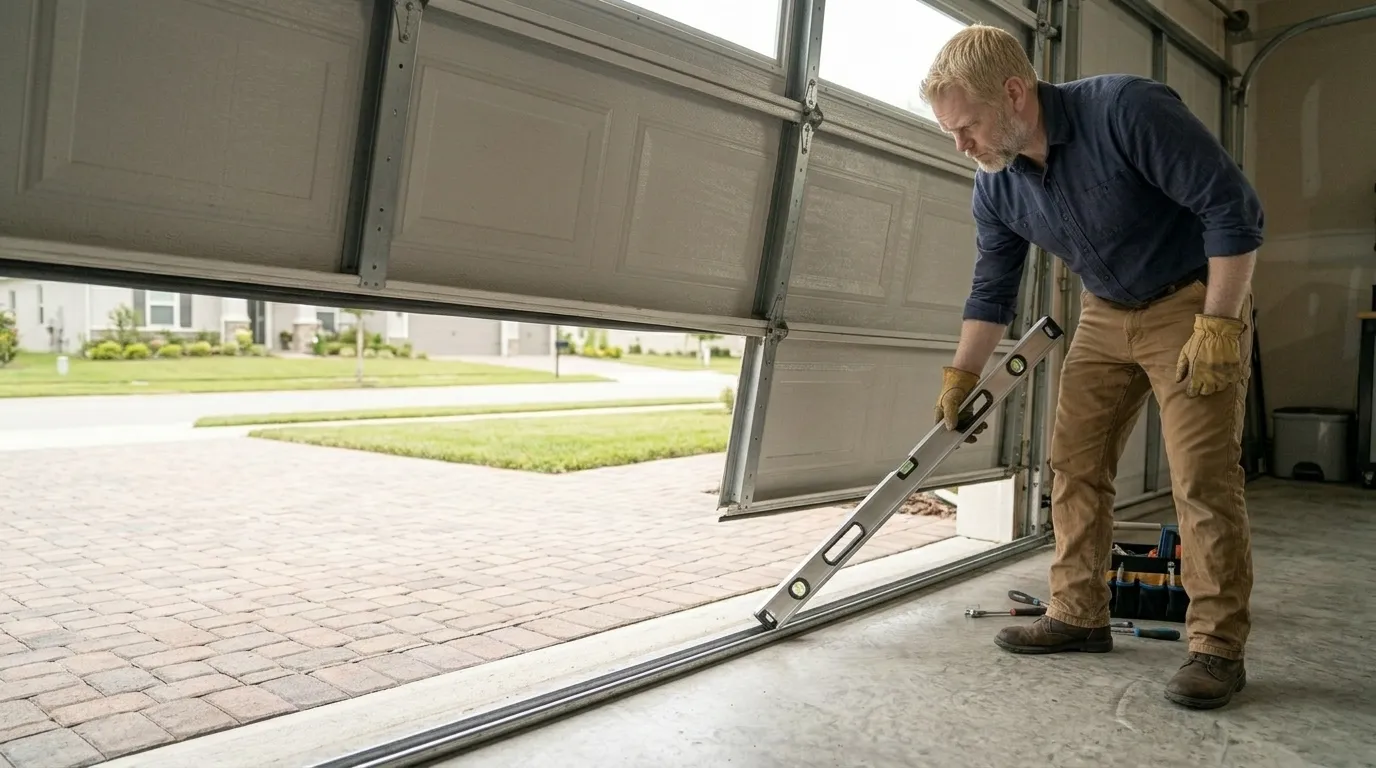
The most common surprise on a newer-stock install like Ontario's is framing that looks standard until you get a level on it - forty years of settling can put a quarter-inch of lean into a header that was square when it went up. That's a small fix if we catch it before the door's ordered, and an expensive one if we catch it after. The other place this goes wrong is opener compatibility: a lot of these houses have had one opener swap already, sometimes with mounting brackets that don't match the original hardware. We check what's actually bolted to the header, not what the box says, before we quote a new opener. And we'll say this plainly - if your existing door is structurally sound and the only issue is an aging opener, a full new-door install is the wrong sell. We'll tell you that instead of installing over a working door just because that's the appointment on the books.
DIY or pro
A lot of homeowners in this area are comfortable doing their own weatherstripping swap or replacing a roller, and that's a reasonable DIY job on a standard-width door.
What we don't recommend doing yourself is anything involving the torsion spring - the wound tension in a spring sized for a full sectional door can cause serious injury if it's released wrong, and that's true whether the door is five years old or fifty.
New installation itself is also not a solo weekend project: getting the opening measurements wrong by even a small margin means a door that binds in the track under cold-weather contraction, which is exactly the failure this climate band produces.
If you're set on doing the labor yourself, at minimum have someone check the spring sizing and the header attachment before the door goes in - those two things are the hardest to fix after the fact.
Questions
Yes. Ontario's median build year runs around 1983, noticeably newer than the service area's overall median near 1957 with most stock pre-1960. That means Ontario homes typically have later-generation door openings and track hardware, which changes what parts fit and what usually fails first.
No. We run out of Mansfield, about 4 miles away, and drive out for every visit. There's no local depot or standing crew stationed in Ontario - every job here is scheduled from the Mansfield shop.
This area sits in a severe cold climate band, and freeze-thaw cycling is hard on bottom seals and on torsion springs sized wrong for the door's actual weight. We spec seals rated for sustained cold and size springs to the finished door weight, not the builder default, to keep the door from binding in winter.
Not if the door itself is sound. If the panel, springs, and track are in good shape and the opener is the only failing part, a full door replacement isn't the right fix and we'll say so rather than sell a job that isn't needed.
Explore more
Ready when you are
Mansfield Garage Door Pros repairs and installs garage doors, springs and openers in Mansfield, OH and the surrounding area.