
Bottom Panel Curb Salt Damage
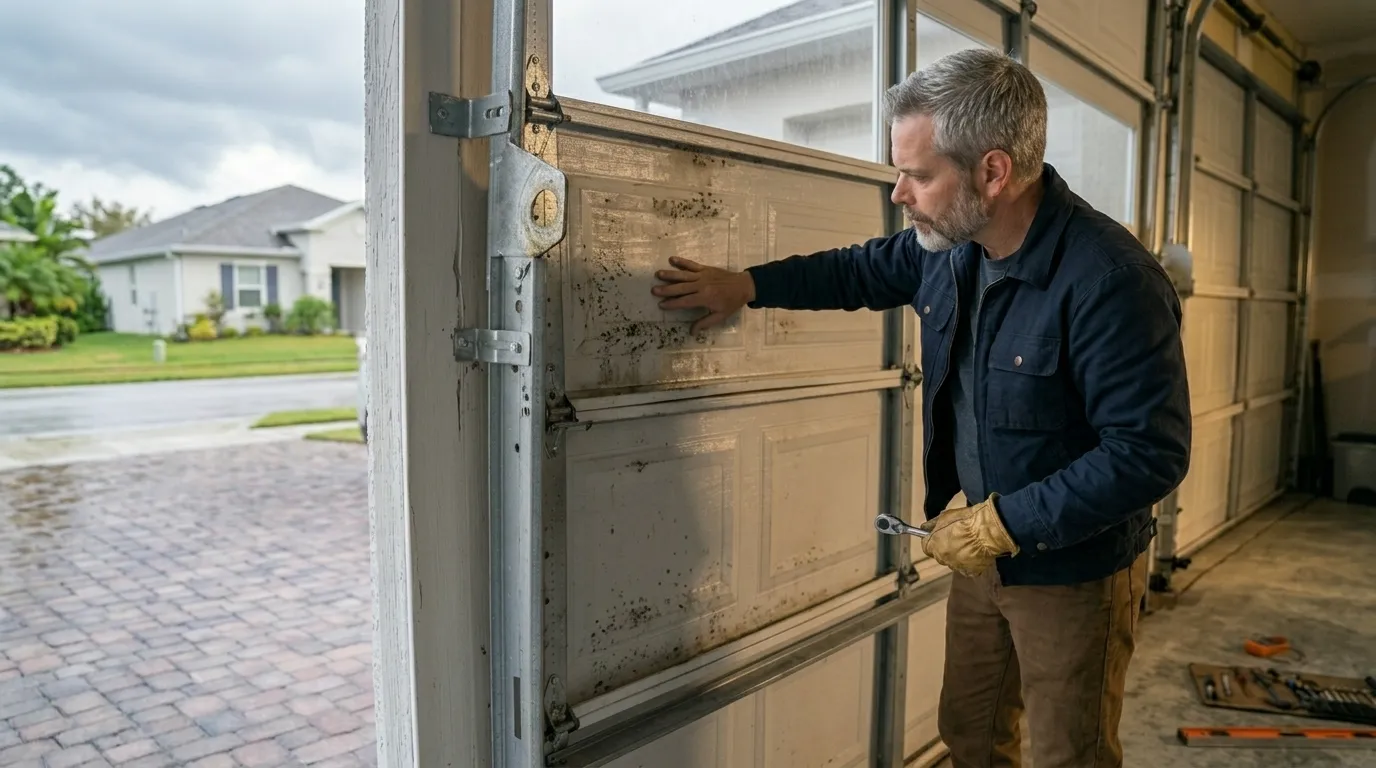
On doors from Crestline's era, you'll often find the damage concentrated on the bottom two panels, since those take the brunt of curb strikes, road salt spray, and standing water at the base of the track.
Crestline, Mansfield
Crestline homes mostly went up in the mid-1950s, and their steel panel doors show it. Mansfield Garage Door Pros travels 11 miles out to fix or replace damaged sections.

Local causes
Crestline's housing stock centers on 1956, right in the middle of the wider 1938-1983 range across this part of the county. Doors built or replaced to match that era's construction were flat steel or fiberglass sections, often without the foam-core insulation that came standard later. That matters for panel replacement because a lot of these doors have single-layer skins - thin steel that dents, cracks, and rusts through faster than a two-layer insulated section would. When a car bumper catches the bottom panel or a winter freeze-thaw cycle splits a seam, you're not dealing with a door built to shrug it off. You're dealing with 60-plus-year-old sheet metal that was never meant to flex twice in one afternoon the way it will on a night that swings from 20 degrees to 40. The climate here runs cold and severe enough that thin panels contract and pop rivets or hinge screws that a warmer region's doors never have to deal with. That's the setup: an older, thinner door skin meeting a climate that stresses it hard twice a year, at freeze and at thaw.
Symptoms
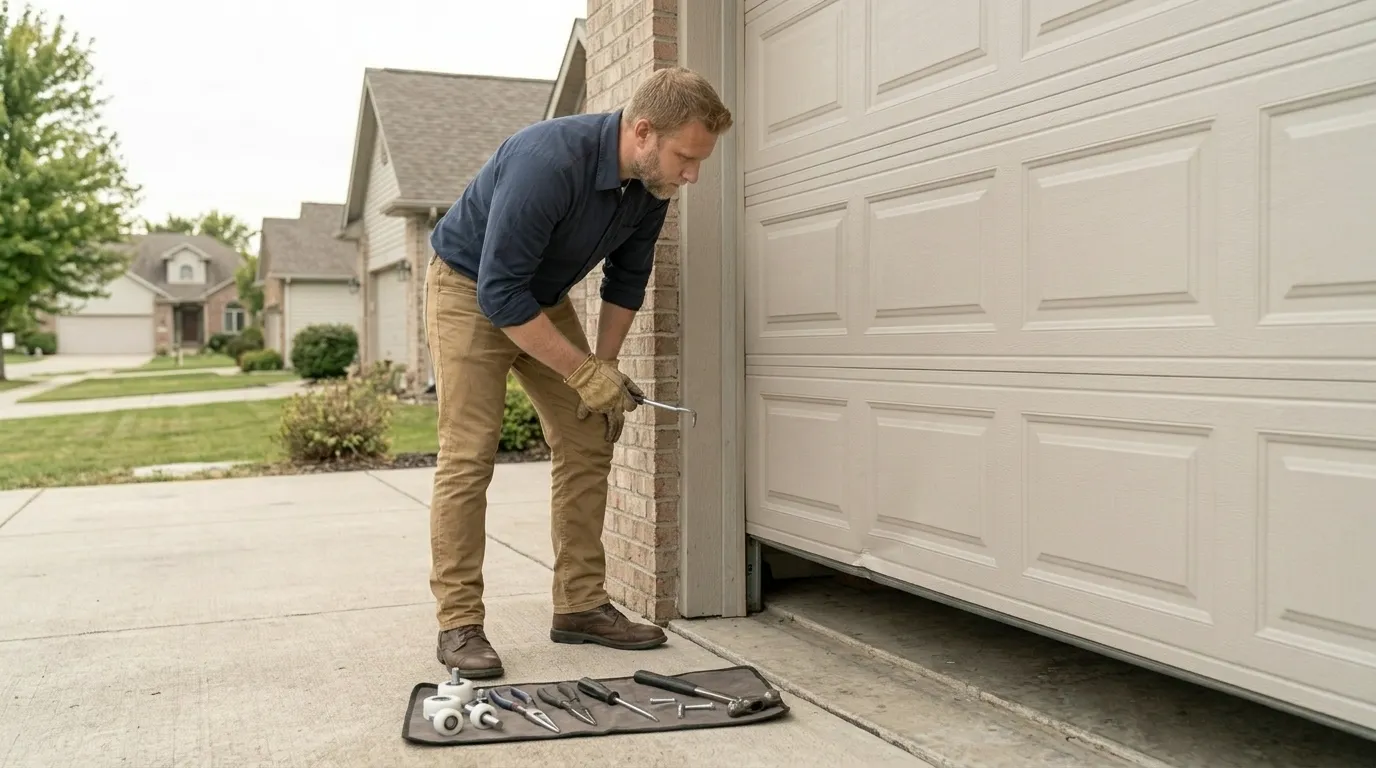
The tell is usually a single section that's visibly different from the rest - a dent that's pushed in far enough to bind the rollers, a rust line along the bottom edge where snowmelt sat against the steel, or a crack where a hinge bolt pulled through.
On doors from Crestline's era, you'll often find the damage concentrated on the bottom two panels, since those take the brunt of curb strikes, road salt spray, and standing water at the base of the track.
If the door still opens but drags, scrapes, or binds on one side as it travels, that's the bent panel pulling the whole assembly out of square - not the opener struggling, even though that's usually what gets blamed first.
Job timing
A single-panel swap on a door built to this era's dimensions is usually a half-day job once the truck is out from Mansfield, assuming the section matches or a close replacement panel is available.
The complication comes when the original manufacturer no longer makes a matching profile - not uncommon on doors this old - and the whole door needs to come off in favor of a full replacement instead of a patch.
That decision gets made on site, not over the phone, because you can't tell how bad the track alignment is until someone's hands are on it.
Pricing
I don't have a set price to quote here, and I'm not going to make one up. What I can tell you is that this stretch of the county runs a lower median household income than the wider service area - roughly $48,298 here against $58,607 across the full territory - which is worth knowing because it shapes the advice you'll get on site: patch versus replace isn't just a technical call, it's a budget one, and a straight answer about which panel is worth saving matters more here than a sales pitch for a full new door.
DIY or pro
If the damage is cosmetic - a shallow dent that doesn't affect the roller track or the seams - you can sometimes live with it or pop it out yourself with basic tools. What you shouldn't do is unbolt a panel on a torsion-spring door without knowing exactly how that spring is loaded. Doors from the 1950s and 60s often carry side-mounted torsion hardware that doesn't match what's sold in stores now, and the risk isn't just doing the job wrong - it's a spring letting go while your hands are on the section above it.
Watch-outs
The job goes sideways when someone tries to force a modern replacement panel onto a track and hinge spacing built for a door that predates current standard sizing. Panels from this era don't always share dimensions with what's stocked today, and a section that's a half-inch off will bind every single cycle until something - the roller, the hinge, or the opener - gives out. The other way it goes wrong is treating a bent panel as an isolated fix when the track itself got knocked out of alignment in the same impact; replace the panel and skip the track check, and you'll be back out here in a month for the same complaint.
Questions
Not always. A lot of doors on houses built around 1956 use panel profiles that manufacturers stopped producing years ago. Sometimes a close match works fine; sometimes the mismatch is visible enough, or affects the seal, that a full door replacement makes more sense than a patch. We'll tell you which on site.
About 11 miles from Mansfield. We travel out for panel jobs regularly; there's no local branch here, the truck just comes from Mansfield each time.
Sometimes. If the dent is shallow and doesn't touch a seam, hinge point, or the roller track, you can leave it and just keep an eye on it. Once it starts affecting how the door travels or seals, it's not cosmetic anymore.
Explore more
Ready when you are
Mansfield Garage Door Pros repairs and installs garage doors, springs and openers in Mansfield, OH and the surrounding area.